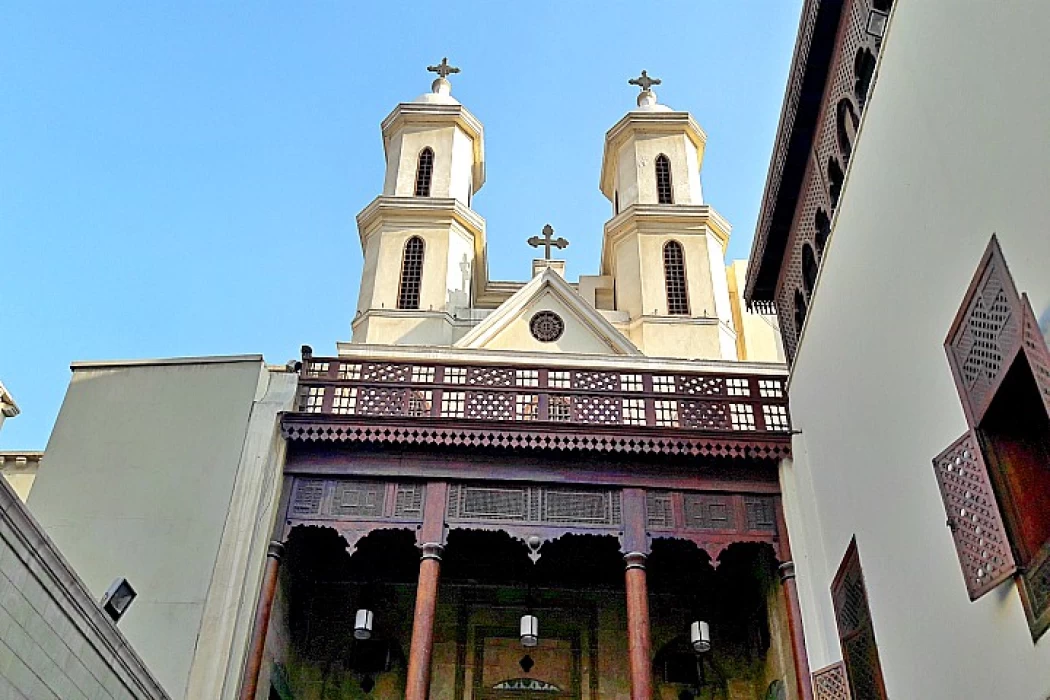
The Hanging Church
Hanging Church
A historical and architectural masterpiece in the center of Cairo
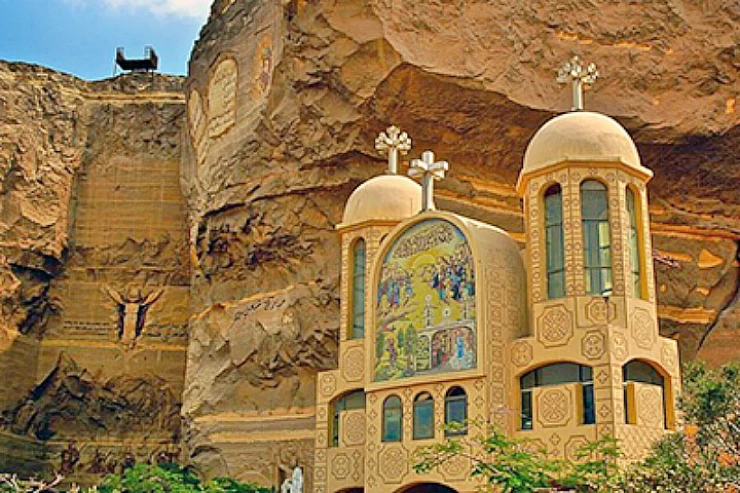
The Hanging Church is one of the oldest and most famous Coptic Orthodox churches in Egypt, located in Cairo's Old Cairo neighbourhood.
It is characterized by its unique location above the gate of the Roman fortress Babylon, which is why it is called the Hanging Church. This church is a symbol of Coptic heritage and a witness to a long history of challenges and achievements.
History of the Hanging Church
Origins and Foundation
The origins of the Hanging Church date back to the third century AD, as it was built on the ruins of one of the towers of the Roman fortress, which was built during the reign of Emperor Trajan (98-117 AD).
The church is believed to have been founded during the fourth or fifth century AD, and through the ages it has remained an important religious centre for Christians in Egypt.
The Roman citadel in Coptic Cairo had its nave hanging over a passageway, and the church was approached by twenty-nine steps; early travellers to Cairo called it the Church of the Stairs. The ground surface has risen by about six meters since Roman times, so most of the Roman tower is buried underground, reducing the visual impact of the church's elevated site.
The Roman citadel in Coptic Cairo had its nave hanging over a passageway, and the church was approached by twenty-nine steps; early travellers to Cairo called it the Church of the Stairs. The ground surface has risen by about six meters since Roman times, so most of the Roman tower is buried underground, reducing the visual impact of the church's elevated site.
Historical and Religious Role
The church was the seat of the Coptic Orthodox patriarch from the seventh to the thirteenth century, where a number of patriarchs lived.
The church witnessed many important historical events, especially during the periods when Copts were persecuted and served as a shelter for them.
It was visited by many Arab travellers and historians, like Al-Maqrizi, who described it as one of the greatest churches in Egypt.
The church was rebuilt several times during the Islamic era, once during the caliphate of Harun al-Rashid, when Patriarch Bishop Mark asked the governor for permission to renovate the church. During the reign of Al-Aziz Bellah, who
authorized Patriarch Ephrem the Syriac to renovate all the churches of Egypt and repair what was destroyed, and a third time during the reign of Al-Zahir to promote the religion of God.
It was the seat of many popes since the eleventh century, and Patriarch Christodoulos was the first to take the Hanging Church as the seat of the Pope of Alexandria, and a few patriarchs were buried in it in the eleventh and twelfth centuries, and there are still pictures and icons of them in the church lit by candles, and trials of priests, bishops, and heretics were held in it as well. It is considered an important shrine for Copts because of its historical antiquity, the place's association with the Holy Family, and its presence among churches and monasteries.
Architecture
Construction and Planning
The Hanging Church has a unique architectural design that combines Byzantine and ancient Coptic styles.
The church is located on the western side of Saint George's Street and is two stories. In front of it, there is a fountain, and it was built in the famous basilica style, consisting of 3 wings, a front hall, and a structure distributed in 3 parts. It is rectangular and relatively small; its dimensions are about 23.5 meters in length, 18.5 meters in width, and 9.5 meters in height. It consists of a main nave and two small wings, with eight columns on each side, and between the nave and the north wing is a row of three columns with large pointed arches, and the columns separating the wings are marble, except for one of black basalt.
The church houses a large number of antique icons, numbering about 110, the oldest of which dates back to the eighth century AD.
Its walls and ceiling feature intricate wooden decorations in the shape of a ship, symbolizing Noah's Ark..
The main altar has a 12th-century ebony and ivory veil with intricate carvings depicting religious scenes.
The main structure
Structure: It includes three main altars dedicated to Jesus Christ, the Virgin Mary, and St. John the Baptist.
Secret passage: The church is said to have secret underground passageways that were used to escape during periods of persecution.
The Holy Well: Located inside the church, it is believed to have been used in ancient times as a source of blessed water.
Wooden pulpit: It dates back to the Middle Ages and is one of the oldest pulpits in Coptic churches.
The Hanging Church in modern times
The church has undergone several restorations over the centuries to preserve its unique structure, most recently in the late 20th century.
Today, it is a prominent tourist and religious shrine, with thousands of tourists visiting it annually from around the world.
Coptic religious services and ceremonies are still held here, reinforcing its spiritual and cultural role in Egyptian society.
Discover the Hanging Church of the Virgin Mary
Al-Muallaqa, or the Hanging Church of the Virgin Mary, is well-known in Egypt for its worldwide recognition of its historic and religious significance. Based in the Old Coptic Cairo region, the historically symbolic religious building stands amid the Old Cairo religious district. Here, tourists from all corners of the world come to visit, enchanted by its architecture and historical significance. In the company of Adam, Salah, and Miron the Copt Museums, The Church of the Hanging, the Ben Ezra Synagogue, Abu Serga Church, and the Coptic Museum, bring the ancient and cultural background of Egypt closer to people than any other site.
Among all the related Egypt tour's regular points, visiting the Hanging Communion of St. Mary's Church is a must. Dubbed the "Hanging Church," it was so called because it was built on top of the former two Roman fortress towers; the place associated with the Coptic faith also had a historical significance with it being the first place of the Coptic patriarchal seat. It transitioned from Alexandria, which at that time was rendered uninhabitable, to Al Fustat, where it found a new home. The physical attribute of being a loft is a standing proof of the genius of its developers as well as the strong belief with which they have been keeping it in all these years.
The Roman Fortress of Babylon
The Hanging Church is situated above the relics of the Roman battlements of the Babylon Fortress. The wall was built during the reign of Emperor Trajan, and it was primarily utilized as a defense system around the Red Sea-Nile Canal. Also called the “Castle of Babylon,” this fortress was constructed to defend the eastern gate of Egypt, and even after the Islamic Conquest, it played an important role in Easter fortifications. The term “Babylon’’ is said to have derived from the story of King Senusret of Ancient Egypt, who is believed to have taken some captives from Babylon in a bid to build the stronghold upwards, creating a barrier to ward danger from one of its sides.
The Hanging Church is one of the oldest in Egypt and has been significant in the history of Coptic Cairo. It was built over the remains of a Roman fort with a ceiling that resembles Noah’s Ark. The Holy Family of Jesus, Mary, and Joseph is said to have fled to this part of the city from King Herod. Entering such a place feels like time travel, where one can picture the Holy Family's travels and ponder their thoughts. Add this to the typical visits to places like Luxor, and Aswan, or a sailing trip on the Nile, and you get a memorable experience in Egypt.
The architectural setup of the Hanging Church is indeed very different from any other church. The interior of the church is designed into a wooden structure that is stylized like Noah’s Ark, and the section of the church is divided into four different wings, each of which is enclosed within good-looking marble pillars. Inside there is also a granite tank and a marbled pulpit that is decorated with mosaic works that are all craftsmanship enduring symbols. The walls of the church carry numerous icons from the 15th century, which allow the visitors to appreciate the complexity of Coptic art.
One of the most breathtaking aspects of the church is the wooden lantern screen, which is decorated with many beautiful icons carved crosses, and geometric patterns made of ebony and ivory. The churches contain artwork and architectural styles that depict the traditions of Coptic Cairo that have been used and admired for centuries.
A Journey Through Time and Faith
Visiting the Hanging Church of the Virgin Mary is an invitation to experience the complex history and religious traditions of Egypt. Thus, it is imperative that whenever a Giza Pyramids and Coptic Cairo one-day tour package is available, it should be embraced, for it will enrich one’s experience of the alluring and rare arts in the country. The Hanging Church is guaranteed to enhance your experience of Egypt, as it has both religious teachings and magnificent designs that are appealing ten times more than its spiritual importance alone.
The early hours of the morning or the late hours of the evening: These moments are best to be spent to avoid people and have a better experience. Besides, the lighting settings during these times are more striking and may even enhance the beauty of the church’s interiors. Weekdays Visiting on a weekday can also mean fewer visitors, as more are most likely to come on weekends, especially on Fridays and Sundays.